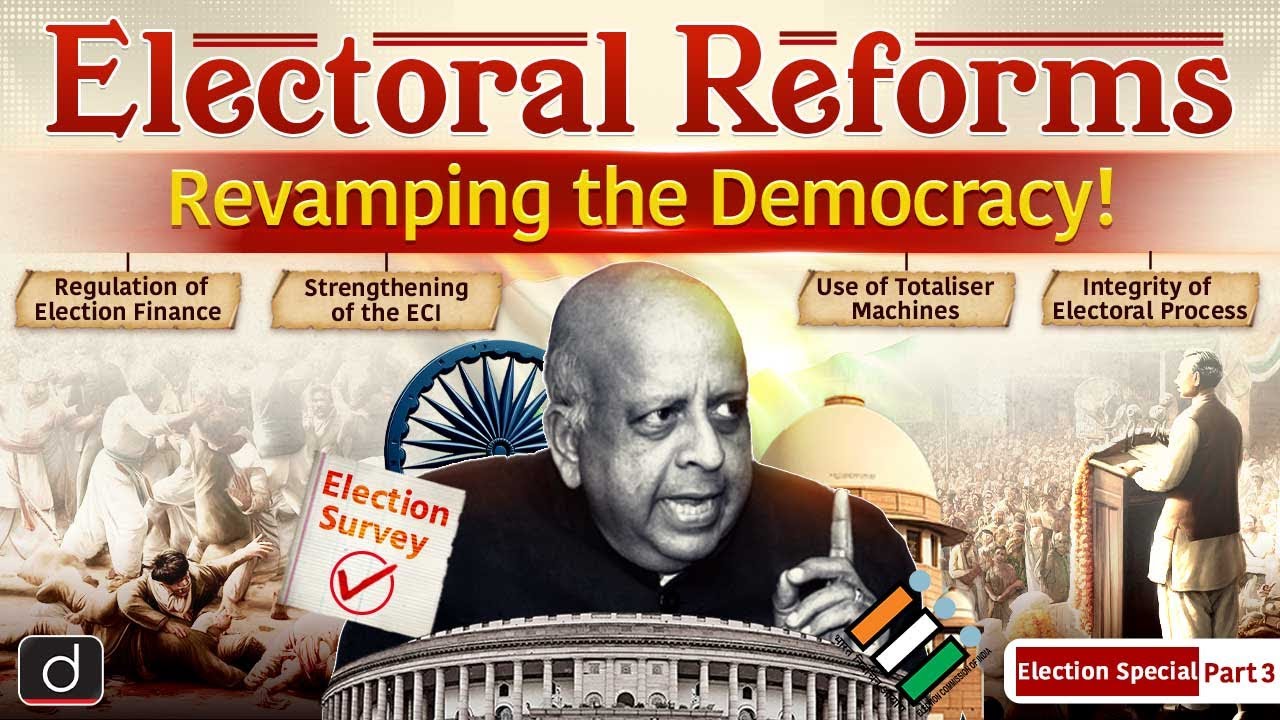
The journey of Electoral Reforms in India after marks a major turning point in how Indian democracy works. During this time, the country introduced key updates to make election systems cleaner, more transparent, and accountable to every citizen. For learners studying Governance and Constitutional Law, understanding these updates helps explain how the world's biggest democracy protects the true power of each individual vote.
🎯 In this chapter, you will understand:
- How rules for Presidential and Vice-Presidential elections were tightened in to ensure only serious candidates apply.
- How staff requisitioning in , postal ballots in , and proxy voting in expanded voting rights.
- The landmark transparency rules requiring candidates to publicly reveal their criminal, financial, and educational records.
- How Rajya Sabha voting changed, how election funding became regulated, and how Braille-enabled EVMs achieved nationwide reach by .
💡 Why this topic matters: Elections are the heart of a free country. By fixing loopholes, stopping unfair money power, and opening up candidate backgrounds, these legal changes ensure that everyday citizens remain the real decision-makers in government.
🧠 Core Idea: Modern electoral changes blend administrative updates, legal rules, and technology so that every election is fair, accessible to all people, and clear to public view.
Evolution of Major Electoral Reforms in India from 1996 to the Modern Era
Starting in the mid-1990s, India realized that its election framework needed better discipline to keep public trust strong across the entire nation. Parliament passed several law updates, while the Election Commission of India introduced fresh administrative steps. Together, these changes helped control bad practices like muscle power and dark money, while giving polling officers the exact support and tools needed to host clean voting across all towns and villages.
Building Trust Through System Discipline: Following the mid-1990s, the nation needed stronger rules to keep elections simple, fair, and reliable for every single voter.
- (i) The core goal was reducing the harmful effect of illegal wealth and force, while making sure election authorities had enough staff and supplies to manage millions of voters safely.
- (ii) These changes touched everything from top leadership positions like the President and Vice-President down to practical voting rights for everyday citizens.
- (iii) The system gradually shifted from old manual paper methods to smart technological tools, including Electronic Voting Machines (EVMs) with Braille features so that voters with special visual needs could participate independently.
Enhancing Dignity in Presidential and Vice-Presidential Contests
To keep the election process for the highest positions in the country organized and respectful, lawmakers realized they needed to stop non-serious participants from filling out nomination forms. In , specific legal updates increased both the required number of supporting lawmakers and the refundable security deposit amount.

Structural Changes to Nominations and Security Deposits
The year was an important landmark year when official rules raised the hurdles for joining the Presidential and Vice-Presidential contest, ensuring that only deeply supported leaders submitted forms.
Raising Proposer and Seconder Numbers: To prove serious political support, candidates now need backing from many more elected lawmakers before filing papers.
- (a) For the office of the President, the required number of proposers and seconders went up dramatically from 10 each to 50 each.
- (b) For the office of the Vice-President, the required number of proposers and seconders was raised from 5 each to 20 each to confirm real legislative backing.
Financial Commitment Rules: Raising monetary deposits helped filter out casual applicants who were not truly competing.
- (a) The security deposit paid during nomination for these top two constitutional positions was raised from a small ₹2,500 to ₹15,000, acting as a genuine pledge of serious intent.
Modernizing Election Staffing and Voting Accessibility
Running elections in the world's most populous democracy takes huge logistical effort and thousands of organized staff members. New legal rules made sure polling stations had trained personnel from public institutions, while giving special groups like soldiers and remote workers secure ways to cast their votes without missing out.
Requisitioning of Staff and Institutional Support
In , the law clearly allowed election managers to temporarily borrow employees from public organizations across the nation so that every local polling booth had sufficient officials on voting day.
- (i) Election authorities could formally request staff from local municipal bodies, national banks, and state universities to help run voting centers.
- (ii) Public service workers from the Life Insurance Corporation (LIC), Public Sector Undertakings (PSUs), and government-funded schools or colleges were made available for official election duty.
Innovations in Voting: Postal Ballots and Proxy Systems
To help citizens who cannot physically reach their hometown polling booth on election day, flexible voting formats were created to safeguard everyone's fundamental right to vote.
Postal Ballot Framework (): Voting by mail became officially organized for specialized groups of workers.
- (a) The Election Commission received formal authority to announce specific categories of voters—such as essential duty workers—who could safely vote using a secure postal ballot.
Proxy Voting for Service Voters (): Military members stationed far away received a tailored voting option.
- (a) This reform specifically helped members of the Armed Forces and service members governed by the Army Act who guard national borders.
- (b) These service voters were given the legal right to choose an official representative (a proxy) to submit a vote on their behalf in their home constituency following approved rules.
The Transparency Revolution: Mandatory Candidate Disclosures
A huge shift happened in that changed Indian politics forever. The law gave voters a full "Right to Know" about who was asking for their votes. From that point on, anyone filing nomination papers for Parliament or State Legislative Assemblies had to legally share clear facts about their criminal past, wealth, and school education.
Mandatory Declarations in Nomination Papers
Every political candidate must now sign a detailed sworn document (affidavit) covering key personal information before their name is added to the official ballot paper.
- (i) Criminal Record: Full detail of any past court convictions, acquittals, or periods spent in jail must be stated clearly.
- (ii) Pending Cases: Candidates must declare any ongoing court cases where they are accused of crimes carrying 2 years or more of potential jail time.
- (iii) Financial Wealth: Full lists of all assets, house properties, cash, bank accounts, and financial debts owned by the candidate, their husband or wife, and dependent children.
- (iv) Public Dues: Any unpaid bills, government loans, or debts owed to public banks and official agencies must be listed.
- (v) Educational Background: Clear disclosure of the highest school or college degree completed by the candidate.
Legal Consequences for Falsehoods
To make sure candidates tell the truth on their forms, strict legal penalties were set for anyone who tries to hide facts or write lies.
- (i) Giving false statements or hiding required facts on nomination papers is treated as a serious punishable crime.
- (ii) A candidate found guilty of lying on these forms can face jail time up to 6 months, a cash fine, or both.
Redefining the Upper House: Rajya Sabha Reforms of 2003
The Rajya Sabha (Council of States) serves as the upper house of India's Parliament. In , lawmakers changed two major rules to make sure members represented real political ideas and that voting stayed completely honest without secret money deals influencing the results.
Eliminating Residence Barriers and Secret Ballots
These crucial updates made upper house contests simpler while stopping party members from secretly breaking party promises during voting.
- (i) Removal of Domicile Requirement: A leader no longer needs to live in or be registered as a local voter in the specific state they represent in the Rajya Sabha; being a registered voter anywhere in India is fully legal.
- (ii) The Open Ballot System: To stop money influence and hidden cross-voting, secret paper voting was removed. State lawmakers voting in Rajya Sabha elections must now show their marked ballot paper to their authorized political party agent before dropping it in the box.
Regulating the Flow of Money: Election Expenditure and Funding
Financial updates made in aimed to bring fair play into campaign finances, encourage clean digital banking donations, and provide equal public media coverage for all recognized political parties.
Candidate Expenses and Media Access
The law drew clear lines between individual candidate expenses and general party campaigns so leaders were not penalized fairly for large national rallies.
- (i) Travel Cost Rules: Money spent on travel by famous party leaders and major political figures (known as star campaigners) is not counted inside the individual candidate's personal expense ceiling.
- (ii) Fair Media Distribution: The Election Commission got formal power to divide free TV and radio airtime on government and cable networks fairly among recognized parties based on past election performance.
- (iii) Free Voter Lists: To help recognized political parties prepare, the government supplies them with free copies of official voter lists (electoral rolls) before voting starts.
Incentivizing Transparent Political Contributions
Clear tracking rules helped check where political money came from while offering tax savings to honest citizens and businesses who donated through official channels.
- (i) Reporting Limits: Any single political gift or donation above ₹20,000 must be officially reported by the political party to the Election Commission.
- (ii) Company and Personal Gifts: Parties can accept money gifts from everyday citizens and private firms, but donations from government-owned companies remain completely illegal.
- (iii) Tax Discounts: Money given to registered political parties through official banks qualifies for income tax deductions, encouraging clean traceable donations.
Technological Empowerment: Braille-Enabled EVMs
Making sure citizens with complete or partial vision loss could vote without depending on anyone else was a historic victory for disability rights and voter equality in India.
The Rollout of Assistive Voting Technology
Adding raised Braille symbols onto voting machine panels transformed the voting process, giving every visually challenged voter total privacy at the polling booth.
- (i) The first real test of Braille ballot features took place during the Asifnagar Assembly bye-election in Andhra Pradesh.
- (ii) Great feedback led to expanded use across state assembly elections between and .
- (iii) Nationwide Adoption: By the General Elections (15th Lok Sabha), Braille-enabled EVMs were deployed at every polling booth across all states in India.
⚡ Quick Revision Capsule: Summary of Electoral Reforms (1996–2009)
Here is a quick overview table covering the major electoral law updates passed between 1996 and 2009 for fast study and review:
| Year | Reform Focus | Key Changes Implemented |
|---|---|---|
| Presidential & Vice-Presidential Elections | Raised proposers/seconders (50 for President, 20 for Vice-President); increased security deposit to ₹15,000. | |
| Election Staffing | Allowed borrowing (requisitioning) of staff from local bodies, banks, universities, LIC, and PSUs for polling duties. | |
| & | Voting Accessibility | Introduced postal ballots () and proxy voting for armed forces service voters (). |
| Candidate Background Declarations | Mandated sworn disclosures of criminal cases, financial assets/debts, and school/college degrees. | |
| Rajya Sabha Voting System | Removed state residence rule for candidates; introduced open ballot system to stop hidden cross-voting. | |
| Party Finances & Spending Rules | Excluded star campaigner travel from candidate limits; mandated public reporting for donations over ₹20,000; gave tax relief for clean gifts. | |
| – | Braille Voting Features on EVMs | Tested in and fully deployed across all polling booths nationwide by the Lok Sabha election. |
📝 Summary
The Electoral Reforms in India post- have transformed how elections are conducted across the nation. By creating clear candidate disclosure laws in , opening up Rajya Sabha ballots, protecting military voting rights, regulating campaign funding, and adding Braille features to EVMs by , India made sure that its constitutional system remains fair, modern, and open to all citizens. Studying these updates provides essential knowledge for mastering Indian polity and democratic governance.
🚀 Quick Revision Points
Essential facts to review before examinations:
- (i) Presidential Election Rules (): Increased proposers/seconders to 50 for President and 20 for Vice-President, setting the security deposit at ₹15,000.
- (ii) Staff Requisitioning (): Enabled borrowing employees from public sector banks, universities, LIC, and state PSUs for polling booth duty.
- (iii) Candidate Declarations (): Legal requirement to declare criminal background, financial assets/liabilities, public debts, and educational qualification.
- (iv) Rajya Sabha Updates (): Ended state residence requirement and introduced open ballot voting to maintain party discipline.
- (v) Assistive EVM Technology (): Complete nationwide rollout of Braille-enabled EVMs for visually impaired citizens.
- 💡 Exam Tip: Pay special attention to the year during revision—it brought three landmark changes: candidate background disclosures, Rajya Sabha open ballot voting, and proxy voting for armed forces service members.
❓ Frequently Asked Questions (FAQ)
Q1: What are the proposer and seconder requirements for Presidential elections in India?
A1: Following the amendment, a Presidential candidate needs 50 proposers and 50 seconders from elected lawmakers, along with a security deposit of ₹15,000.Q2: What background details must a candidate declare under the 2003 disclosure rules?
A2: Candidates must declare any past criminal convictions or pending criminal cases (punishable by 2 or more years of jail), personal and family financial assets/liabilities, government debts, and their highest educational qualification.Q3: Why was the open ballot system introduced in Rajya Sabha elections in 2003?
A3: The open ballot system was introduced to prevent corruption, money influence, and secret cross-voting by requiring state legislators to show their marked ballot to their authorized party agent before casting their vote.